Showing posts with label new media. Show all posts

Sunday, August 14, 2011

Tethered to Technology

I recently reactivated my Facebook account after disabling it for almost two and a half weeks. I deactivated it because I felt I was being bullied and I didn't need that stress on top of all the other stressors that were coming at me from work, from my GRE exam, from trying to meet deadlines in my classes. It was just as well, I thought, because, I was starting to procrastinate BADLY due to the addicting habit of reading updates every 30 minutes and checking other people's walls and photos.

I figured I needed to go on an FB diet.

I was amused by the text on the screens that instructed me how to commit FB suicide. One screen featured random profile photos of people on my friends list. Below the photos, it read: "A will miss you." "B will miss you." "C will miss you." I found it funny because FB really knew how to appeal to one's emotional side -- and I almost gave in. The attribution of feelings by this system to disembodied photos of people labeled "friends" gave one the impression that, the system itself was a friend, advising another against saying leaving without saying goodbye...and all those trite cinematic situations to which we're so attuned. Even if the photos of people they featured were just nominally friends -- and in fact, were ones with whom I have not interacted with for a long time -- it did get me thinking. Would people really miss my presence? Would others even notice? care? I figured I'd find out. When I finally clicked the "deactivate account" button, FB told me "We hope you return soon," or something like that.

It was bittersweet, parting with the communities and groups I identified with online, and shared unique life experiences with. I quickly realized how much of my self was sketched by the interactions certain people and I had, the kinds of exchanges we'd have on our walls, and how, somehow, I revelled in the fact that "others" could see whom I was "talking" with and what we were discussing. This indeed offered some form of legitimacy to my own perception of who Data was, and who I was projecting myself as to other people. Now that I was no longer connected to them, I had to negotiate with myself: just where and when did I start anchoring my identity on experiences long gone, and with people with whom I have not had any common experiences with since? It made me realize just how deeply these virtual experiences could shape how we see ourselves, and even our lives...all because we invited ourselves to do this.

So this made me thankful that I decided to let go of FB when I did. I was able to study better. I was spending less time online and found myself reading, talking to people face to face, actually having some time to myself! I spent a weekend out of town with the hubby, and I was glad I didn't have FB breathing down my neck: although the habit was difficult to break, I successfully resisted posting photos and status messages about my weekend. Suddenly, we had the time ONLY to ourselves, and the compulsion to tell everyone where you were and what you were doing helped define a private space again. No one knew, no one could "see," no one could judge. It was liberating. And for the first time in a long time, my mind was present in the moment. I wasn't thinking about how this would look on FB or who would be interested. It was all about me and the hubby and our vacation. And it was good.

I will admit, however, that I could not let go completely. I had to be tethered to something...just in case. Twitter was the dock peg of choice. Though I was not able to share a lot of media as on FB, I was, at least, contactable to my followers and those I was following. I still had a toe in the virtual pow-wow. I still needed to know what people were talking about and what they were sharing. I suppose it was also my way of reminding people that I still existed, although I felt that I was starting from scratch, building up a new community again. However I noticed that on Twitter, people were more independent in their thoughts. Sure, they may retweet links or messages, but generally individuals on Twitter seemed to stand "alone." They didn't need to plugged into any group and were solely accountable for all that they tweeted. There was no one to back you up with a "like" or a comment -- if they did it would come several tweets later, when others already made up their mind about what you just wrote. It called for a certain disposition of responsibility -- at least in my view. I found myself correcting my tweets, checking and rechecking links I wanted to retweet. I made sure my posts could fit the character limit but still be sensible -- without resorting to text spelling.

Again it forced one to be in the moment, and to appreciate the small things -- which for me are a reflection of one's politeness and even compassion. Why impose your horrendous spelling and grammar on an innocent audience?

Eventually I decided to reactivate my account. I found out people had been asking about me and wondering what happened to my account. I won't deny it felt nice to be noticed, but then of course, I had to answer people's questions about why I was gone. I decided to be vague, and instead just reassure them I was back.

Unfortunately, I realized it wasn't as easy to come back as it was to leave. Not only is my profile still un-visit-able, some contacts were having trouble even tagging me. The hubby said, perhaps the system needed time to propagate. All right, but, does it take five days to get it up and running like before? It's starting to frustrate me, and for all my fantasizing about people actually "missing" me, turns out, I am still probably just another profile on the system. This time, however, I am sort of a ghost: people can see "me", but they can't "touch" me. I am un-connect-able.

I left, thinking I was being noticed for the wrong reasons, and I came back, noticeably unconnected, virtually just an "other." There wasn't even any emotional welcome back message from FB either, none of the sentimental farewell ones that appear when you're going through the deactivation process. I suppose FB felt when deactivation occurs, there's one less profile to maintain, but when it's reactivated, they're not too happy with the additional work to get it functioning properly like before. They're too busy, so they'll skip the welcome party.

This is fine with me. The past two weeks showed me that I can discipline myself regarding my use of technology and I can regulate my consumption of social media products. I also know which people are truly my friends, online and offline. I can define who they are to me and who I am according to the encounters we've had in real life -- and I don't need to depend on FB's categories to tell me if I am accepted in certain groups or not. Technology is important but it need not run our lives, not does it have to define who we are. We define technology's function in our lives, and make it work for us, not the other way around.

Thursday, November 04, 2010

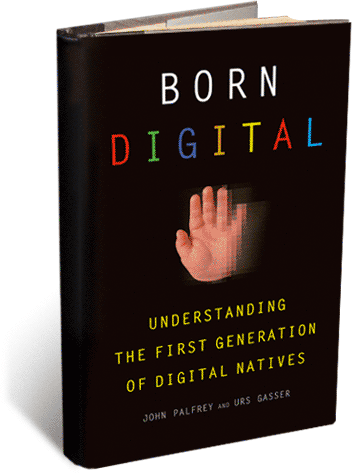
A Jewel of a Book

I nearly knocked over a National Bookstore book shelf a few days ago in my hysteria at seeing a copy of a book I've been salivating over for the last two years. Urs Gasser and John Palfrey's Born Digital: Understanding the First Generation of Digital Natives, is, to my mind, one of the seminal works about the online lives of today's younger generation.

Gasser and Palfrey say that kids born after 1980 are considered the Digital Natives, those born knowing nothing but the digital world. The implications of these are huge, as they have to deal with issues previous generations didn't even have to think about, including privacy, access to information, even the changing nature of how we simply consume media and information.

It's an exciting foray into scenarios that typify life in the next decade. Everything from shifting to malleable identities, the creation and collaboration online, a public sphere where everyone can finally participate. However it rightly deals with the issue of the information and digital divide, including how some nations are proposing legislation to keep certain websites blocked, and the information filtered. Other issues deal with the issue of political economy, and how those with more money and education naturally have more access.

I'm still reading it, and I've a ways to go but I anticipate an enlightening read. I'm excited to find out about their recommendations regarding new media literacies and how people like me can join the campaign.

I think we all need to be part of the campaign.

The internet and the web will be around for a long time, and may evolve into a whole new organism before long. We all need to learn how to navigate it now, with the kids, so that we may teach the future generations how to do it better.

Saturday, October 09, 2010

Globalization in Reverse: nothing comes close to chicken adobo


It's undeniable.

Pinoys, whether born in the Motherland or not will always have their brains and taste buds wired for the distinct taste of Filipino food. The flavors of home-cooked meals come at you from all directions, at once savory and sweet, hot and cool, pungent and sharply salty or sour.

However more than the food, I am attracted to this video for the way it globalizes the local -- glocalization, that business and political buzzword that has been used so liberally the past decade. Culturally it is used to define how new communication technologies are catapulting otherwise unknown aspects of a community onto the global stage. Sociologist Anthony Giddens defines it as "not just an 'out there' phenomenon, but an 'in-here' phenomenon" as well.

This video, by a Filipino living overseas named dvalix (according to his YouTube channel) must have created this video on a recent visit to Manila, to see family. Here I am particularly interested with how glocalization has permeated the everyday: using the catchy pop song "California Girls" by Katy Perry, he tries to organize his experience of the culture by focusing on food. Matching his created lyrics to the beat, and creating the particular video to illustrate his meaning, he uses the same device as Perry does in her song: singling out particular practices, activities, even manners of dressing and mundane, everyday experiences to heighten a particular Californian's identity.

Visuals of home-cooked meals and the set-up of the family table with plates stacked high, several cuts of scenes with big broods around a table, eating. Endless visuals of standard Filipino vayan, especially fried lumpia, pepper the music video. People in the act of eating and chewing, and in some instances holding up the food to their faces as if happily presenting it to the world and equating the foodstuff with their identity, seem to underscore just how important or how central food is to Filipino culture. He pays particular homage to the Filipinos' "national food," singing:
"you can travel the world, but nothing comes close to chicken adobo."

Sharing a meal, anywhere, has been considered a social event. dvalix however zooms in on how socialization with food in the Philippines takes them to the beach, where they eat pancit, or how one is sure to eat all the time because of the many parties a balikbayan is invited to. Panning shots of food set up in restaurants imply that family outings are anchored on food.

It is also family that seems to have defined for dvalix what good food is. Video of extended family gathered around the table, and close-ups of them savoring the bites of their food emphasize how lutong-bahay is a phenomenon that many overseas-born Filipinos find particularly quaint -- having no sense of the kasambahay who cooks for them on a daily basis. In one part of the video, he sings about how, when "mama tries to cook, everyone grabs [the food]." He implies how sinigang should be served ("be careful! Don't touch the bowl"), and lays down the proper pairing for "fried fresh fish" with the video showing the no-frills presentation of mangga, itlog na maalat, kamatis at sibuyas.

dvalix doesn't miss out on some unique Filipino practices as well: he mentions drinking coconut juice from its shell and juxtaposes it with drinking Coke from a "plastic bag." Visuals of fresh fish, typically stacked the way they would be in a wet market imply he had a close encounter with a palengke. Activities such as riding a jeepney and tricycle, using a magic mic, and even mixing msg in a pot of water serve to highlight the peculiarities of the Pinoy. All these are only possible outside of tourist-y travel deals, home-grown customs and activities that can only be passed down by family members and the communities they grew up in.

Though some may find these mundane, I believe these are the "everyday" things balikbayans and overseas-born Filipinos crave. These scenes are from experiences that are rooted in the culture of the everyday, the culture that is lived and is struggled with in order to survive. The phenomena of the everyday are alien to these overseas-born Filipinos but they need to find a way to connect to the experiences. The best way for them is to use familiar memes ("California Girls," t-shirts with the words "adobo" and "sinigang") to construct their idea of Filipino culture in the Motherland. As a unique kind of visitor, the experience is compounded on many levels (being a Filipino born overseas, rediscovering roots, discovering unique customs for the first time, similarities with customs practiced "at home" in the United States, etc.).

Taking available forms (pop songs, video, music) to "adequately" express their feelings and insights about the experience as it happens allows them to transmit these "raw" data. While this opens up questions of exoticization and welcomes discussions on constructions of Filipino identity, I believe it is videos like these that will serve to document and create for the global (even nomadic) Filipino a sense of knowing that there is more to what even our local media present the Philippines to be. It is from personal experiences and individual stories that we get more raw, less conglomerate-mediated perspectives of what it is to be a certain identity, or not, having been born/living in one place but struggling with a strong sense of being from a totally different lineage.

The new media and the technological tools allow us to tell those stories, and sing the songs that help define, or redefine for us the Filipino identity. It's also a constant negotiation. Many may agree with dvalix's presentation/interpretation of the Filipino culture, and others may not. In fact the creator may even change his tact after another visit. But I believe it's all right for our identities to be fluid. These content provide markers for us, buoys if you will, in an ocean of information and reconstruction. It's the exercise that matters, the opening up of the discussion, and the exchanges that will allow communities, online and offline, to keep these artifacts of Filipino culture (or any culture fort that matter) alive.

Friday, October 08, 2010

New Media and Pedagogy

The University of the Philippines honored five of the students' favorite faculty members at the Great Ideas symposium on Wednesday, 6 October. The Great Ideas Project aims to highlight the great ideas -- projects, activities, passions and pedagogies -- of the faculty members of the University, and in turn inspire others to come up with their own great ideas as well.

Think brilliant, spread brilliance was this year's slogan, and five brilliant professors out of the over 400 other brilliant professors nominated in the polls, did just that. Check out greatideas.ph to read the abstracts of the winners.

What I found interesting among all these winners is their use of new media, specifically, media found on the web, in their discussions. This jumped out at me as Prof. Gonzales discussed his documentation strategy using digital video; Dr. David's demo of the forecasting software using available photos, video and data on the web; Dr. Gonzales' and Dr. Tolentino's references to YouTube stars and the virality of certain videos on the media-sharing site; and Prof. Billedo's use of social media to explain cyberpsychology.

While appropriating any media in the way we teach is not new, it should be mentioned how these new media figured in the great ideas of these faculty. Scholarship and pedagogy are starting to build around the software, platforms and content on the web. How we begin to approach solutions and explanations to many long-suffering issues and problems are starting to take on new forms. How we think and do things now are informed by the tools and media that are available via the internet.

This begs the question, if the internet were not around now, would these ideas have been born? I think they would still be born, albeit much later in our history, in someone else's brain, with far more effort and more cost. This isn't to say there isn't any effort in what we see today. It's just that, we're lucky this happened in our lifetime, otherwise none of us would probably be alive to even see a hint of these ideas.

Thanks to these ideas, we are able to add infinitely more to our methods, we are able to share and exchange insights in almost real time with our students. We are able to communicate both formally and informally online, and keep those links long after they graduate. We start to build a network and this network suddenly becomes a well of relationships, wisdom and praxis both students and faculty can draw from. I am particularly interested with how Prof. Gonzales and Prof. Billedo have successfully integrated new media into their methods. Their use of the media endears themselves to their students, and there is a sense of understanding. In an information glut human beings want to be identified, want to be understood as individuals.

This is what their use of the new media allows these professors to do: it opens up a venue for students to express their individuality, preference, beliefs, passions and desires in a familiar, unthreatening way. When they know they are on safe ground, in an environment that is open to their opinions, they will be less inhibited, they will have impassioned exchanges, and subsequently learn from their peers, and learn from doing.

It's a great way to build true confidence in kids. They need that confidence and self esteem to properly navigate their identities online, and not fall prey to the bullying and influencing that can happen online. It takes a strong character and self-awareness to safely navigate the many unexplored territories of the Web. But we use those very tools that were employed to create it, to teach kids to trek through it safely.

It is this confidence to speak out that allows them to throw their great ideas out there. It is the self-awareness and self-esteem that allows them to see their ideas through to fruition. They've been trained using the web, now they can go conquer it. Many say using the Web can seriously affect learning and attention spans; it will make them more prone to plagiarism and induce them to laziness. But if we as teachers show them the potential to use these tools responsibly and use these tools to inspire change, then we have an army of change agents at our fingertips.

What is important to me is that they are here now - the internet, the Web, the new media, the students -- and we have the means to spread these ideas, right on the very platform that inspired or pegged the great ideas in the first place. Here is a genuine way to share and collaborate, to pass on best practices, to document processes and pass it on. Here is a way to study and teach, and reach out to generations still waiting to be born.

Wednesday, October 06, 2010

The Future of TV is here

This is it guys! Google is ready to take center stage in the age of convergence.

GoogleTV is set to launch a whole new experience in television viewing and web surfing. Google TV now allows us to see graphic information right from our television sets while interacting online. If you visit the GoogleTV website, you'll see all the different features it offers, including apps (yes, just like the ones on your smart phone), search and a graphic tv homepage.

It's mind blowing, to say the least, that we actually get to see this media form come into being in this century, a mere 20-something years since the internet was made accessible to the public. Now this opens up a floodgate of questions and implications, not least of which are attention spans, content creation, consumption and access.

Among other things. But the good thing is, we no longer have to depend on one tv remote control and go berserk when we misplace it. Our cell phones (smart phones) can now double as tv remotes.

I hope they tell us when and how to subscribe. I can't wait to try it out.