Showing posts with label internet. Show all posts

Thursday, January 19, 2012

Then End of a Conversation and the Death of Creativity


If SOPA/PIPA gets passed in the US Congress next week, we could face an unprecedented violation of our creative agencies, face criminal charges for the vaguest definitions of piracy and face new levels and dimensions of discrimination.

The acts which the US Congress claims will put a stop to piracy through several provisions (read about it here, here and here) but the act fails to ignore the deeper, more critical effects it will have culturally and socially for the coming digital generations.

First, it will affect how people communicate online. If our conversations offline are peppered with references to media and pop cultural artifacts, our online dialogues go a step further and provide links to these very media. Some writers claim that, because of the ambiguity and broadness of the provisions, licensing companies like Disney may invoke these provisions for the sharing of these media links in comment boxes by people in social networks.

This points to a second consequence -- that of sharing. Ideas, projects, even businesses were created through the conversations online, through the exchanging of materials and media. People on the web contribute to programming projects online, remix audio-visual materials and create new artforms. This involves building on previous creations, thoughts, reactions (see Lawrence Lessig's Freeculture) that people willingly share in the spirit of cultural growth. Is SOPA and PIPA do become laws, that freedom to speak one's mind and share ideas may be curbed, out of the fear of overstepping the (vague) lines that define online piracy. The web itself was born because of Sir Tim Berners Lee's idea that the web, and people's access to it, should be unhindered. There are provisions in SOPA and PIPA that imply immunity for those who voluntarily "squeal" on suspected "pirates." Trust is broken. Sharing stops. Knowledge disappears.


The US Congress thinks passing these acts into law only apply to their citizens, or those who live in the US. They forget that boundaries crumble on the web, and everyone, anywhere they are are all citizens on the web. Because many servers are housed in the US, most, if not nearly all of us who have made virtual homes on the web, are affected by these policies. How will the US implement measures that do not discriminate against non-US ISPs? If the acts are strictly for US companies and entities, how do they get past the glocal expressions of their media products?

This discriminates, in my view, user-producers in developing countries. Without the same physical and capital muscle countries like the Philippines will be at the mercy of these provisions. Most of the Philippines' ISPs offshore servers are in the US, server space shared with US companies. As one of the most prolific content generators on the web, Filipinos find expression by remixing material from the West through parody or just plain fun. But we learn because we share and without that freedom and agency they suppress further the ability to access more knowledge.

With the web and social media now an inextricable part of our lives, we are in a constant conversation, one that does not end and didn't begin at any particular point in time. While some may argue that this becomes a nuisance and a time sucker, our asynchronous and tethered-ness to one another is the reason why the knowledge base of humanity can now be accessed through simple dialogue, link-passing and collaboration.

This is a new age of creativity. The most fecund of ideas find expression no longer housed in material goods but in ongoing conversations through time and across physical space. Putting up nets and traps around the web only means killing some of the most basic skills that has brought humanity this far in history -- thinking, creativity and collaboration. It's a new model for survival in the digital age and if SOPA and PIPA are given the go, and if the US Congress fails to change their paradigm, we can be sure we will see the beginning of the end of human innovation in our lifetimes.

Thursday, January 13, 2011

Clickety click

I'm feeling the pressure to be online.

Because of my self-proclaimed ambition to build an expertise about the web and new media, I have been hearing the familiar critical, nagging voice in my head berating me for not posting more often, reading more often, exploring more often. In a world that is increasingly wired and where information is exchanged and is accessible in a snort, I am constantly on edge when I am not online. It's as if there are a million things to do that don't get done -- that's in addition to the things that don't get done in the offline world.

It's a shame I'm not online more often to do some substantial work and writing. Real life gets in the way, not to mention the laundry, sleeping and and having coffee. Instead I browse FB, then find myself going off to other sites when a thought hits me. I end up not finishing what I started. Most of the time I forget what I started. THus, more things end up not getting done.

Take for instance my application to a university in the US. I have been staring at my laptop for the past three weeks, trying to finish the dang application essay. I've typed something, but it's far from being acceptable. And so off I go checking samples online. I hop and hop til the time I allotted for the task has run out. Oh world wide web. Why do you tempt me so?

But I suppose it's not because of the Web, but because I procrastinate and compare what I have with the others have. I am locked into a cycle of analysis paralysis because of all the information that overwhelms me. And all of these are available as long as I type the right word.

Ka-Ching! Another reason to stall.

Sometimes all the options at our fingertips can make it harder to decide. While we benefit from the access we suffer too from information glut. There has to be a way to get over the addiction of searching and clicking hyperlinks. While the offline world presents many viable options, I think the most effective one is to simply turn of the wi-fi router, and remember there's still an analog world to deal with, and a life to live, outside of the web.

It's 2011. I hope to write more, be distracted less, love more, criticize less, explore more, berate myself less. Smile more, hug more, give thanks. And it will all start with this happy medium.

Wednesday, November 24, 2010

The Walking Dead

or close to it. Aside from trying to catch up with academic duties, there are administrative and personal obligations that have to be fulfilled. In between trying to make sense of the overwhelming workload, one texts, shoots off emails, manages FB profiles and tries to organize lessons on a laptop. And still I feel like nothing gets done.

Or maybe we want too much done.

The fine line that separates home and work has blurred so that one continues to plod through office backlog while in bed as new items fill email inboxes. There's a compulsion to check, and then we never stop checking. The to-do list becomes irrelevant, because it doesn't seem to ever "empty." As one task gets crossed off the list, another is added. Updating the list itself becomes a huge task.

My only measure now of how much work I've been doing is volume of laundry and the thickness of the dust gathering on my window. It reminds me that I'm home and that aside from living on the Web, I also live in the physical world. Too bad the it's only on the Web that people don't mind so much if I smell or not.

FLASH REPORT!

This just in: a tweet from Maria Ressa about an article from the Harvard Business Review, which also talks about the work-life balance in the internet age. :)

Thursday, November 04, 2010

A Jewel of a Book

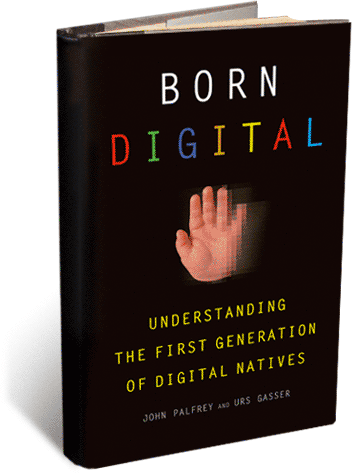
I nearly knocked over a National Bookstore book shelf a few days ago in my hysteria at seeing a copy of a book I've been salivating over for the last two years. Urs Gasser and John Palfrey's Born Digital: Understanding the First Generation of Digital Natives, is, to my mind, one of the seminal works about the online lives of today's younger generation.

Gasser and Palfrey say that kids born after 1980 are considered the Digital Natives, those born knowing nothing but the digital world. The implications of these are huge, as they have to deal with issues previous generations didn't even have to think about, including privacy, access to information, even the changing nature of how we simply consume media and information.

It's an exciting foray into scenarios that typify life in the next decade. Everything from shifting to malleable identities, the creation and collaboration online, a public sphere where everyone can finally participate. However it rightly deals with the issue of the information and digital divide, including how some nations are proposing legislation to keep certain websites blocked, and the information filtered. Other issues deal with the issue of political economy, and how those with more money and education naturally have more access.

I'm still reading it, and I've a ways to go but I anticipate an enlightening read. I'm excited to find out about their recommendations regarding new media literacies and how people like me can join the campaign.

I think we all need to be part of the campaign.

The internet and the web will be around for a long time, and may evolve into a whole new organism before long. We all need to learn how to navigate it now, with the kids, so that we may teach the future generations how to do it better.

Friday, October 08, 2010

New Media and Pedagogy

The University of the Philippines honored five of the students' favorite faculty members at the Great Ideas symposium on Wednesday, 6 October. The Great Ideas Project aims to highlight the great ideas -- projects, activities, passions and pedagogies -- of the faculty members of the University, and in turn inspire others to come up with their own great ideas as well.

Think brilliant, spread brilliance was this year's slogan, and five brilliant professors out of the over 400 other brilliant professors nominated in the polls, did just that. Check out greatideas.ph to read the abstracts of the winners.

What I found interesting among all these winners is their use of new media, specifically, media found on the web, in their discussions. This jumped out at me as Prof. Gonzales discussed his documentation strategy using digital video; Dr. David's demo of the forecasting software using available photos, video and data on the web; Dr. Gonzales' and Dr. Tolentino's references to YouTube stars and the virality of certain videos on the media-sharing site; and Prof. Billedo's use of social media to explain cyberpsychology.

While appropriating any media in the way we teach is not new, it should be mentioned how these new media figured in the great ideas of these faculty. Scholarship and pedagogy are starting to build around the software, platforms and content on the web. How we begin to approach solutions and explanations to many long-suffering issues and problems are starting to take on new forms. How we think and do things now are informed by the tools and media that are available via the internet.

This begs the question, if the internet were not around now, would these ideas have been born? I think they would still be born, albeit much later in our history, in someone else's brain, with far more effort and more cost. This isn't to say there isn't any effort in what we see today. It's just that, we're lucky this happened in our lifetime, otherwise none of us would probably be alive to even see a hint of these ideas.

Thanks to these ideas, we are able to add infinitely more to our methods, we are able to share and exchange insights in almost real time with our students. We are able to communicate both formally and informally online, and keep those links long after they graduate. We start to build a network and this network suddenly becomes a well of relationships, wisdom and praxis both students and faculty can draw from. I am particularly interested with how Prof. Gonzales and Prof. Billedo have successfully integrated new media into their methods. Their use of the media endears themselves to their students, and there is a sense of understanding. In an information glut human beings want to be identified, want to be understood as individuals.

This is what their use of the new media allows these professors to do: it opens up a venue for students to express their individuality, preference, beliefs, passions and desires in a familiar, unthreatening way. When they know they are on safe ground, in an environment that is open to their opinions, they will be less inhibited, they will have impassioned exchanges, and subsequently learn from their peers, and learn from doing.

It's a great way to build true confidence in kids. They need that confidence and self esteem to properly navigate their identities online, and not fall prey to the bullying and influencing that can happen online. It takes a strong character and self-awareness to safely navigate the many unexplored territories of the Web. But we use those very tools that were employed to create it, to teach kids to trek through it safely.

It is this confidence to speak out that allows them to throw their great ideas out there. It is the self-awareness and self-esteem that allows them to see their ideas through to fruition. They've been trained using the web, now they can go conquer it. Many say using the Web can seriously affect learning and attention spans; it will make them more prone to plagiarism and induce them to laziness. But if we as teachers show them the potential to use these tools responsibly and use these tools to inspire change, then we have an army of change agents at our fingertips.

What is important to me is that they are here now - the internet, the Web, the new media, the students -- and we have the means to spread these ideas, right on the very platform that inspired or pegged the great ideas in the first place. Here is a genuine way to share and collaborate, to pass on best practices, to document processes and pass it on. Here is a way to study and teach, and reach out to generations still waiting to be born.

Monday, October 04, 2010

The Great Thing about the Internet

is that you can start over.

And so here it is, my "Starting Over," season 35, episode 5. This is a personal and professional (and passionate) attempt to revive my life as a blogger.

This naturally presupposes I actually HAVE time to THINK. Time -- the one commodity isn't easy to come by these days, filled as it is with all sorts of tasks and distractions, but I have to MAKE that time.

So the theme of this episode is MAKING TIME to THINK. Hopefully this blog will be proof positive that I can turn off all other stimuli and let my brain breathe and relax long enough to produce something substantial.

Cheers to a new effort, and a new semester!