or close to it. Aside from trying to catch up with academic duties, there are administrative and personal obligations that have to be fulfilled. In between trying to make sense of the overwhelming workload, one texts, shoots off emails, manages FB profiles and tries to organize lessons on a laptop. And still I feel like nothing gets done.
Or maybe we want too much done.
The fine line that separates home and work has blurred so that one continues to plod through office backlog while in bed as new items fill email inboxes. There's a compulsion to check, and then we never stop checking. The to-do list becomes irrelevant, because it doesn't seem to ever "empty." As one task gets crossed off the list, another is added. Updating the list itself becomes a huge task.
My only measure now of how much work I've been doing is volume of laundry and the thickness of the dust gathering on my window. It reminds me that I'm home and that aside from living on the Web, I also live in the physical world. Too bad the it's only on the Web that people don't mind so much if I smell or not.
FLASH REPORT!
This just in: a tweet from Maria Ressa about an article from the Harvard Business Review, which also talks about the work-life balance in the internet age. :)
Wednesday, November 24, 2010

Monday, November 08, 2010
The Syllabus Link
Hello Comm 150 Students!
You may download the syllabus HERE.
Please let me know if there are any broken hyperlinks in the document. See you next week!
DTC
You may download the syllabus HERE.
Please let me know if there are any broken hyperlinks in the document. See you next week!
DTC
Thursday, November 04, 2010
A Jewel of a Book
I nearly knocked over a National Bookstore book shelf a few days ago in my hysteria at seeing a copy of a book I've been salivating over for the last two years. Urs Gasser and John Palfrey's Born Digital: Understanding the First Generation of Digital Natives, is, to my mind, one of the seminal works about the online lives of today's younger generation.
Gasser and Palfrey say that kids born after 1980 are considered the Digital Natives, those born knowing nothing but the digital world. The implications of these are huge, as they have to deal with issues previous generations didn't even have to think about, including privacy, access to information, even the changing nature of how we simply consume media and information.
It's an exciting foray into scenarios that typify life in the next decade. Everything from shifting to malleable identities, the creation and collaboration online, a public sphere where everyone can finally participate. However it rightly deals with the issue of the information and digital divide, including how some nations are proposing legislation to keep certain websites blocked, and the information filtered. Other issues deal with the issue of political economy, and how those with more money and education naturally have more access.
I'm still reading it, and I've a ways to go but I anticipate an enlightening read. I'm excited to find out about their recommendations regarding new media literacies and how people like me can join the campaign.
I think we all need to be part of the campaign.
The internet and the web will be around for a long time, and may evolve into a whole new organism before long. We all need to learn how to navigate it now, with the kids, so that we may teach the future generations how to do it better.
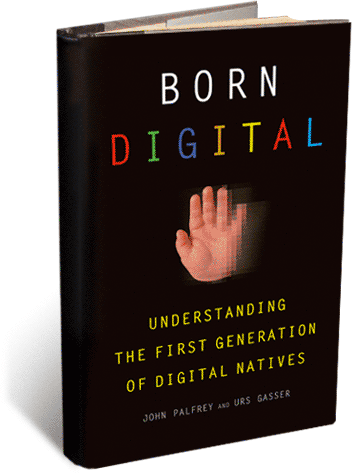
Gasser and Palfrey say that kids born after 1980 are considered the Digital Natives, those born knowing nothing but the digital world. The implications of these are huge, as they have to deal with issues previous generations didn't even have to think about, including privacy, access to information, even the changing nature of how we simply consume media and information.
It's an exciting foray into scenarios that typify life in the next decade. Everything from shifting to malleable identities, the creation and collaboration online, a public sphere where everyone can finally participate. However it rightly deals with the issue of the information and digital divide, including how some nations are proposing legislation to keep certain websites blocked, and the information filtered. Other issues deal with the issue of political economy, and how those with more money and education naturally have more access.
I'm still reading it, and I've a ways to go but I anticipate an enlightening read. I'm excited to find out about their recommendations regarding new media literacies and how people like me can join the campaign.
I think we all need to be part of the campaign.
The internet and the web will be around for a long time, and may evolve into a whole new organism before long. We all need to learn how to navigate it now, with the kids, so that we may teach the future generations how to do it better.
Subscribe to:
Posts (Atom)