I found it ironic that I should be listening to the last few minutes of NU 107's broadcast on my cellphone, while watching and reading tweets of devotion and kudos on my laptop, via the internet. I suppose it's a symptom of the digital times, a far cry from the way radio was once experienced.
The "Home of NuRock" fashioned itself as an innovator on the FM band, differentiating itself from its counterparts by playing non-mainstream music, and featuring independent and obscure musicians in its playlists. Growing up in the 80s, I came to associate NU listeners as the cool ones, enigmatic schoolmates and friends who seemed to float on a different plane of musical preference. I remember, on many occasions, being asked what station I listened to -- this was usually the standard getting-to-know-you line it seemed. When I as much as mentioned NU, the station's avid listeners would raise their palms in a high-five, while the "others" would give out a soft, slightly impressed "aaaahhhhh." I guess we all knew the music was different, the artists almost unheard of, and the DJs spoke English with a near-perfect accent in that slightly detached, "I know you know I'm cool so why should I even bother articulating it" tone.
NU's fan/audience base was built in the late 80s to early 90s, catering to punk, indie and new wave music aficionados and "alternative" content. Outlasting its predecessor, 102 DWXB, NU provided became a platform for launching independent Filipino bands and artists, and a gateway to music genres removed from the mainstream, top 40 hits played by other radio stations. When the Pinoy Band scene erupted in the early 90s with the raw sounds of the Eraserheads, Rivermaya, Put3Ska, and Yano, NU became the launch pad of choice. This brought new and loyal listeners alike onto common ground, and seemed to create a market for these new Pinoy rock musicians. Moreover, younger generations of listeners were reintroduced to the classic Pinoy rock sounds of The Jerks and Juan de la Cruz Band.
Tuning in and actually waiting for your favorite song to be played was the traditional way of patronizing the content. And because music licenses and physical recordings then were difficult (and expensive) to come by (obscure = rare = costly, the law of supply and demand), purchasing channels were limited and focused on NU. However as technology improved, and digital rendering of music became ubiquitous, acquiring the CDs became easier and cheaper. Soon it wasn't only NU that had access to the music; other radio stations could afford to invest in it too, if it meant being able to grab a share of NUs audiences . As the technology became massively available to listeners in portable form, music lovers spent close to nothing in acquiring the music they wanted. No more waiting for hours on the radio, no more spending thousands of pesos on CDs. Peer to peer technology allowed the audiences to collect their songs and make their own playlists.
I don't know for sure if the DJs or artists themselves ever considered this a threat. But for sure the businessmen and financial investors were concerned. What was a scarce resource no longer seemed in short supply on the web. Suddenly, the audiences themselves were the businessmen's biggest competition.
Definitely one cannot discount the changing business landscape of the mass media in the Philippines, and the world because of the internet, and the speed with which it assimilated itself into our lives. New business models and profit strategies emerged in the wake of digital connectivity and two great financial crises in the last two decades alone. The goal of earning revenue and partaking of the thinning financial resources forced like-business outfits to merge and be bought out by one financial entity. With more stations to carry ad content, the more clients will feel they're getting their investments' worth. The more stations acquired, the more audiences the are able to reach and "collect". But for the plan to be viable, the acquired entities need a homogenous flavor, to appeal to as wide a mass audience as possible,
What a lot of those in the old paradigm miss is that audiences who are part of the spread of music is a formidable ally in pushing the integrity and credibility of a product or movement. The audience just has to believe in it to pass it on. Old marketing models that are hinged on the cost-benefit ratio of the material, tangible form/structures are slowly growing obsolete. What strategists need to embrace is the realization that they no longer dictate what the hits are; their audiences now have the ability to join in on the discussion; not in the conference room, but through their mobile and internet devices. If any of the businessmen need proof of this, one just has to take a look at the videos that captured the final moments of NU 107's broadcast. Through word of mouth, people gathered outside the station to see it sign off. No incentives offered, no recognition promised. In fact it was they who spent on their transportation fare, gas, and time to be there. It was something they believed in, and they saw it through to its Huling El Bimbo. The lights and sounds have been captured on a portable camera/video phone and uploaded on the web, passed around via social networking sites. This is proof that though NU 107 as an entity, a physical space, is no more, it will live on in many forms, relived through just as many gadgets,immortalized and brought to life every time songs are played on individual playlists and their final video is viewed online.
I should send a tweet out to my friend that the video is up.
Wednesday, December 01, 2010

Wednesday, November 24, 2010
The Walking Dead
or close to it. Aside from trying to catch up with academic duties, there are administrative and personal obligations that have to be fulfilled. In between trying to make sense of the overwhelming workload, one texts, shoots off emails, manages FB profiles and tries to organize lessons on a laptop. And still I feel like nothing gets done.
Or maybe we want too much done.
The fine line that separates home and work has blurred so that one continues to plod through office backlog while in bed as new items fill email inboxes. There's a compulsion to check, and then we never stop checking. The to-do list becomes irrelevant, because it doesn't seem to ever "empty." As one task gets crossed off the list, another is added. Updating the list itself becomes a huge task.
My only measure now of how much work I've been doing is volume of laundry and the thickness of the dust gathering on my window. It reminds me that I'm home and that aside from living on the Web, I also live in the physical world. Too bad the it's only on the Web that people don't mind so much if I smell or not.
FLASH REPORT!
This just in: a tweet from Maria Ressa about an article from the Harvard Business Review, which also talks about the work-life balance in the internet age. :)
Or maybe we want too much done.
The fine line that separates home and work has blurred so that one continues to plod through office backlog while in bed as new items fill email inboxes. There's a compulsion to check, and then we never stop checking. The to-do list becomes irrelevant, because it doesn't seem to ever "empty." As one task gets crossed off the list, another is added. Updating the list itself becomes a huge task.
My only measure now of how much work I've been doing is volume of laundry and the thickness of the dust gathering on my window. It reminds me that I'm home and that aside from living on the Web, I also live in the physical world. Too bad the it's only on the Web that people don't mind so much if I smell or not.
FLASH REPORT!
This just in: a tweet from Maria Ressa about an article from the Harvard Business Review, which also talks about the work-life balance in the internet age. :)
Monday, November 08, 2010
The Syllabus Link
Hello Comm 150 Students!
You may download the syllabus HERE.
Please let me know if there are any broken hyperlinks in the document. See you next week!
DTC
You may download the syllabus HERE.
Please let me know if there are any broken hyperlinks in the document. See you next week!
DTC
Thursday, November 04, 2010
A Jewel of a Book
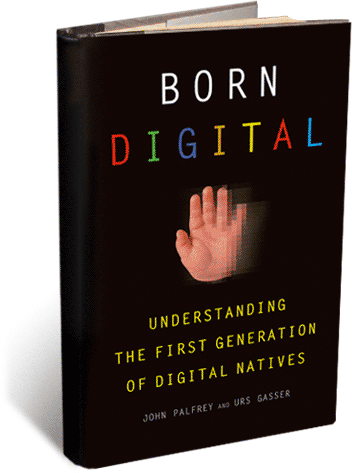
I nearly knocked over a National Bookstore book shelf a few days ago in my hysteria at seeing a copy of a book I've been salivating over for the last two years. Urs Gasser and John Palfrey's Born Digital: Understanding the First Generation of Digital Natives, is, to my mind, one of the seminal works about the online lives of today's younger generation.
Gasser and Palfrey say that kids born after 1980 are considered the Digital Natives, those born knowing nothing but the digital world. The implications of these are huge, as they have to deal with issues previous generations didn't even have to think about, including privacy, access to information, even the changing nature of how we simply consume media and information.
It's an exciting foray into scenarios that typify life in the next decade. Everything from shifting to malleable identities, the creation and collaboration online, a public sphere where everyone can finally participate. However it rightly deals with the issue of the information and digital divide, including how some nations are proposing legislation to keep certain websites blocked, and the information filtered. Other issues deal with the issue of political economy, and how those with more money and education naturally have more access.
I'm still reading it, and I've a ways to go but I anticipate an enlightening read. I'm excited to find out about their recommendations regarding new media literacies and how people like me can join the campaign.
I think we all need to be part of the campaign.
The internet and the web will be around for a long time, and may evolve into a whole new organism before long. We all need to learn how to navigate it now, with the kids, so that we may teach the future generations how to do it better.
Gasser and Palfrey say that kids born after 1980 are considered the Digital Natives, those born knowing nothing but the digital world. The implications of these are huge, as they have to deal with issues previous generations didn't even have to think about, including privacy, access to information, even the changing nature of how we simply consume media and information.
It's an exciting foray into scenarios that typify life in the next decade. Everything from shifting to malleable identities, the creation and collaboration online, a public sphere where everyone can finally participate. However it rightly deals with the issue of the information and digital divide, including how some nations are proposing legislation to keep certain websites blocked, and the information filtered. Other issues deal with the issue of political economy, and how those with more money and education naturally have more access.
I'm still reading it, and I've a ways to go but I anticipate an enlightening read. I'm excited to find out about their recommendations regarding new media literacies and how people like me can join the campaign.
I think we all need to be part of the campaign.
The internet and the web will be around for a long time, and may evolve into a whole new organism before long. We all need to learn how to navigate it now, with the kids, so that we may teach the future generations how to do it better.
Friday, October 29, 2010
Salud should shut up
If it weren't for her mobile phone, presence of mind and courage, we would not have proof of how blatantly some of our public officials s*** on the dignity and human rights of our OFWs.
May I just remind you, Mr. Salud, that our OFWs provide 13% of our GDP. That's nearly $17.40 BILLION that our OFWs earn for this ungrateful country of corrupt, plagiarizing, imbecilic public servants. They're the ones keeping this country, well, a country.
We don't provide jobs for them then we disrespect them? How would Salud and his ilk feel if they were made to watch other people's children, clean toilets that aren't theirs, and suffer emotional, verbal, sexual and physical abuse from their employers...who can't even communicate with them?
I'd like to see him try. No, I'd like to see him live as an OFW for a year and then suffer the same thing he did to Tenorio. The difference is, he won't be able to leave his employer.
If that won't happen will someone just chuck him out of the airplane the next time he flies? kthxbai.
May I just remind you, Mr. Salud, that our OFWs provide 13% of our GDP. That's nearly $17.40 BILLION that our OFWs earn for this ungrateful country of corrupt, plagiarizing, imbecilic public servants. They're the ones keeping this country, well, a country.
We don't provide jobs for them then we disrespect them? How would Salud and his ilk feel if they were made to watch other people's children, clean toilets that aren't theirs, and suffer emotional, verbal, sexual and physical abuse from their employers...who can't even communicate with them?
I'd like to see him try. No, I'd like to see him live as an OFW for a year and then suffer the same thing he did to Tenorio. The difference is, he won't be able to leave his employer.
If that won't happen will someone just chuck him out of the airplane the next time he flies? kthxbai.
Friday, October 22, 2010
The Ultimate YouTube playlist
They are redefining our visual culture!
YouTube's Play Biennial video fest is showcasing, once again, innovative, groundbreaking ideas in online video. The awarding and event will be streamed live today at 8am from the Guggenheim Museum.
This project is mindblowing on so many levels!
First, there's the concept of creating the even itself: submissions and views from literally, all over the world. Practically no restrictions in the topics, styles, technology, language, treatment of the videos allows a free flow of ideas and creativity. The partnership with the Guggenheim Museum, where, according to the YouTube channel on the Play Biennial says, video is now exhibited alongside paintings and sculpture. It's a celebration of technology and the unleashing of ideas; an open dam of creativity and expression. Most of all it is one of the signposts of a changing media culture. It's redefining how a generation of human beings are maximizing the tools to learn from each other, collaborate and subvert the superstructures that used to dictate how we were supposed to see the world.
We are changing right before our eyes. And we're putting it all up on YouTube for others to see.
WOW!
How is this new media ecology changing you?
Check out the event page on YouTube. The omnibus plug alone is awesome!
Thursday, October 14, 2010
A fitting tribute
Nothing captures the drama and spirit of an event like this as video does.
The rescue of the 33 Chilean miners trapped for two months in a mine in the Atacama desert was "made for television," said one kibitzer. I think it was made to be captured and shared on video at the very least, because I am not sure if there is any prime time news program that would air the full 14-minute or so video of each miner being brought to the surface.
On Philippine news, this would have been cut up to about 2 minutes, to augment the voice overs accompanying the newscast. Editorial judgment on which video images to use will be made, and I am willing to bet that only 3-5 of the faces of the 33 miners would be shown. Not that the newscast has any real choice: the nature and form of the news dictates it. The time limit, standards and requirements of video that will help "tell" the story, and the visual hook it needs to keep the audience watching necessitate sifting through the material, choosing and discarding the rest.
However, thanks to the web, we are able to see ALL of their faces. Here they are all identified, which, I think is the proper tribute to be paid to these men. This video was from the CNN website, and I'm glad they wrote in the names of the miners.
Still, it must be noted, the video was edited for brevity. In this instance it was edited precisely to show miners' names and faces. It's another question if there would be any venue or platform that will run the 33 hours (if it exists) of rescue video.
Saturday, October 09, 2010
Globalization in Reverse: nothing comes close to chicken adobo
It's undeniable.
Pinoys, whether born in the Motherland or not will always have their brains and taste buds wired for the distinct taste of Filipino food. The flavors of home-cooked meals come at you from all directions, at once savory and sweet, hot and cool, pungent and sharply salty or sour.
However more than the food, I am attracted to this video for the way it globalizes the local -- glocalization, that business and political buzzword that has been used so liberally the past decade. Culturally it is used to define how new communication technologies are catapulting otherwise unknown aspects of a community onto the global stage. Sociologist Anthony Giddens defines it as "not just an 'out there' phenomenon, but an 'in-here' phenomenon" as well.
This video, by a Filipino living overseas named dvalix (according to his YouTube channel) must have created this video on a recent visit to Manila, to see family. Here I am particularly interested with how glocalization has permeated the everyday: using the catchy pop song "California Girls" by Katy Perry, he tries to organize his experience of the culture by focusing on food. Matching his created lyrics to the beat, and creating the particular video to illustrate his meaning, he uses the same device as Perry does in her song: singling out particular practices, activities, even manners of dressing and mundane, everyday experiences to heighten a particular Californian's identity.
Visuals of home-cooked meals and the set-up of the family table with plates stacked high, several cuts of scenes with big broods around a table, eating. Endless visuals of standard Filipino vayan, especially fried lumpia, pepper the music video. People in the act of eating and chewing, and in some instances holding up the food to their faces as if happily presenting it to the world and equating the foodstuff with their identity, seem to underscore just how important or how central food is to Filipino culture. He pays particular homage to the Filipinos' "national food," singing:
"you can travel the world, but nothing comes close to chicken adobo."
Sharing a meal, anywhere, has been considered a social event. dvalix however zooms in on how socialization with food in the Philippines takes them to the beach, where they eat pancit, or how one is sure to eat all the time because of the many parties a balikbayan is invited to. Panning shots of food set up in restaurants imply that family outings are anchored on food.
It is also family that seems to have defined for dvalix what good food is. Video of extended family gathered around the table, and close-ups of them savoring the bites of their food emphasize how lutong-bahay is a phenomenon that many overseas-born Filipinos find particularly quaint -- having no sense of the kasambahay who cooks for them on a daily basis. In one part of the video, he sings about how, when "mama tries to cook, everyone grabs [the food]." He implies how sinigang should be served ("be careful! Don't touch the bowl"), and lays down the proper pairing for "fried fresh fish" with the video showing the no-frills presentation of mangga, itlog na maalat, kamatis at sibuyas.
dvalix doesn't miss out on some unique Filipino practices as well: he mentions drinking coconut juice from its shell and juxtaposes it with drinking Coke from a "plastic bag." Visuals of fresh fish, typically stacked the way they would be in a wet market imply he had a close encounter with a palengke. Activities such as riding a jeepney and tricycle, using a magic mic, and even mixing msg in a pot of water serve to highlight the peculiarities of the Pinoy. All these are only possible outside of tourist-y travel deals, home-grown customs and activities that can only be passed down by family members and the communities they grew up in.
Though some may find these mundane, I believe these are the "everyday" things balikbayans and overseas-born Filipinos crave. These scenes are from experiences that are rooted in the culture of the everyday, the culture that is lived and is struggled with in order to survive. The phenomena of the everyday are alien to these overseas-born Filipinos but they need to find a way to connect to the experiences. The best way for them is to use familiar memes ("California Girls," t-shirts with the words "adobo" and "sinigang") to construct their idea of Filipino culture in the Motherland. As a unique kind of visitor, the experience is compounded on many levels (being a Filipino born overseas, rediscovering roots, discovering unique customs for the first time, similarities with customs practiced "at home" in the United States, etc.).
Taking available forms (pop songs, video, music) to "adequately" express their feelings and insights about the experience as it happens allows them to transmit these "raw" data. While this opens up questions of exoticization and welcomes discussions on constructions of Filipino identity, I believe it is videos like these that will serve to document and create for the global (even nomadic) Filipino a sense of knowing that there is more to what even our local media present the Philippines to be. It is from personal experiences and individual stories that we get more raw, less conglomerate-mediated perspectives of what it is to be a certain identity, or not, having been born/living in one place but struggling with a strong sense of being from a totally different lineage.
The new media and the technological tools allow us to tell those stories, and sing the songs that help define, or redefine for us the Filipino identity. It's also a constant negotiation. Many may agree with dvalix's presentation/interpretation of the Filipino culture, and others may not. In fact the creator may even change his tact after another visit. But I believe it's all right for our identities to be fluid. These content provide markers for us, buoys if you will, in an ocean of information and reconstruction. It's the exercise that matters, the opening up of the discussion, and the exchanges that will allow communities, online and offline, to keep these artifacts of Filipino culture (or any culture fort that matter) alive.
Friday, October 08, 2010
New Media and Pedagogy
The University of the Philippines honored five of the students' favorite faculty members at the Great Ideas symposium on Wednesday, 6 October. The Great Ideas Project aims to highlight the great ideas -- projects, activities, passions and pedagogies -- of the faculty members of the University, and in turn inspire others to come up with their own great ideas as well.
Think brilliant, spread brilliance was this year's slogan, and five brilliant professors out of the over 400 other brilliant professors nominated in the polls, did just that. Check out greatideas.ph to read the abstracts of the winners.
What I found interesting among all these winners is their use of new media, specifically, media found on the web, in their discussions. This jumped out at me as Prof. Gonzales discussed his documentation strategy using digital video; Dr. David's demo of the forecasting software using available photos, video and data on the web; Dr. Gonzales' and Dr. Tolentino's references to YouTube stars and the virality of certain videos on the media-sharing site; and Prof. Billedo's use of social media to explain cyberpsychology.
While appropriating any media in the way we teach is not new, it should be mentioned how these new media figured in the great ideas of these faculty. Scholarship and pedagogy are starting to build around the software, platforms and content on the web. How we begin to approach solutions and explanations to many long-suffering issues and problems are starting to take on new forms. How we think and do things now are informed by the tools and media that are available via the internet.
This begs the question, if the internet were not around now, would these ideas have been born? I think they would still be born, albeit much later in our history, in someone else's brain, with far more effort and more cost. This isn't to say there isn't any effort in what we see today. It's just that, we're lucky this happened in our lifetime, otherwise none of us would probably be alive to even see a hint of these ideas.
Thanks to these ideas, we are able to add infinitely more to our methods, we are able to share and exchange insights in almost real time with our students. We are able to communicate both formally and informally online, and keep those links long after they graduate. We start to build a network and this network suddenly becomes a well of relationships, wisdom and praxis both students and faculty can draw from. I am particularly interested with how Prof. Gonzales and Prof. Billedo have successfully integrated new media into their methods. Their use of the media endears themselves to their students, and there is a sense of understanding. In an information glut human beings want to be identified, want to be understood as individuals.
This is what their use of the new media allows these professors to do: it opens up a venue for students to express their individuality, preference, beliefs, passions and desires in a familiar, unthreatening way. When they know they are on safe ground, in an environment that is open to their opinions, they will be less inhibited, they will have impassioned exchanges, and subsequently learn from their peers, and learn from doing.
It's a great way to build true confidence in kids. They need that confidence and self esteem to properly navigate their identities online, and not fall prey to the bullying and influencing that can happen online. It takes a strong character and self-awareness to safely navigate the many unexplored territories of the Web. But we use those very tools that were employed to create it, to teach kids to trek through it safely.
It is this confidence to speak out that allows them to throw their great ideas out there. It is the self-awareness and self-esteem that allows them to see their ideas through to fruition. They've been trained using the web, now they can go conquer it. Many say using the Web can seriously affect learning and attention spans; it will make them more prone to plagiarism and induce them to laziness. But if we as teachers show them the potential to use these tools responsibly and use these tools to inspire change, then we have an army of change agents at our fingertips.
What is important to me is that they are here now - the internet, the Web, the new media, the students -- and we have the means to spread these ideas, right on the very platform that inspired or pegged the great ideas in the first place. Here is a genuine way to share and collaborate, to pass on best practices, to document processes and pass it on. Here is a way to study and teach, and reach out to generations still waiting to be born.
Think brilliant, spread brilliance was this year's slogan, and five brilliant professors out of the over 400 other brilliant professors nominated in the polls, did just that. Check out greatideas.ph to read the abstracts of the winners.
What I found interesting among all these winners is their use of new media, specifically, media found on the web, in their discussions. This jumped out at me as Prof. Gonzales discussed his documentation strategy using digital video; Dr. David's demo of the forecasting software using available photos, video and data on the web; Dr. Gonzales' and Dr. Tolentino's references to YouTube stars and the virality of certain videos on the media-sharing site; and Prof. Billedo's use of social media to explain cyberpsychology.
While appropriating any media in the way we teach is not new, it should be mentioned how these new media figured in the great ideas of these faculty. Scholarship and pedagogy are starting to build around the software, platforms and content on the web. How we begin to approach solutions and explanations to many long-suffering issues and problems are starting to take on new forms. How we think and do things now are informed by the tools and media that are available via the internet.
This begs the question, if the internet were not around now, would these ideas have been born? I think they would still be born, albeit much later in our history, in someone else's brain, with far more effort and more cost. This isn't to say there isn't any effort in what we see today. It's just that, we're lucky this happened in our lifetime, otherwise none of us would probably be alive to even see a hint of these ideas.
Thanks to these ideas, we are able to add infinitely more to our methods, we are able to share and exchange insights in almost real time with our students. We are able to communicate both formally and informally online, and keep those links long after they graduate. We start to build a network and this network suddenly becomes a well of relationships, wisdom and praxis both students and faculty can draw from. I am particularly interested with how Prof. Gonzales and Prof. Billedo have successfully integrated new media into their methods. Their use of the media endears themselves to their students, and there is a sense of understanding. In an information glut human beings want to be identified, want to be understood as individuals.
This is what their use of the new media allows these professors to do: it opens up a venue for students to express their individuality, preference, beliefs, passions and desires in a familiar, unthreatening way. When they know they are on safe ground, in an environment that is open to their opinions, they will be less inhibited, they will have impassioned exchanges, and subsequently learn from their peers, and learn from doing.
It's a great way to build true confidence in kids. They need that confidence and self esteem to properly navigate their identities online, and not fall prey to the bullying and influencing that can happen online. It takes a strong character and self-awareness to safely navigate the many unexplored territories of the Web. But we use those very tools that were employed to create it, to teach kids to trek through it safely.
It is this confidence to speak out that allows them to throw their great ideas out there. It is the self-awareness and self-esteem that allows them to see their ideas through to fruition. They've been trained using the web, now they can go conquer it. Many say using the Web can seriously affect learning and attention spans; it will make them more prone to plagiarism and induce them to laziness. But if we as teachers show them the potential to use these tools responsibly and use these tools to inspire change, then we have an army of change agents at our fingertips.
What is important to me is that they are here now - the internet, the Web, the new media, the students -- and we have the means to spread these ideas, right on the very platform that inspired or pegged the great ideas in the first place. Here is a genuine way to share and collaborate, to pass on best practices, to document processes and pass it on. Here is a way to study and teach, and reach out to generations still waiting to be born.
Wednesday, October 06, 2010
The Future of TV is here
This is it guys! Google is ready to take center stage in the age of convergence.
GoogleTV is set to launch a whole new experience in television viewing and web surfing. Google TV now allows us to see graphic information right from our television sets while interacting online. If you visit the GoogleTV website, you'll see all the different features it offers, including apps (yes, just like the ones on your smart phone), search and a graphic tv homepage.
It's mind blowing, to say the least, that we actually get to see this media form come into being in this century, a mere 20-something years since the internet was made accessible to the public. Now this opens up a floodgate of questions and implications, not least of which are attention spans, content creation, consumption and access.
Among other things. But the good thing is, we no longer have to depend on one tv remote control and go berserk when we misplace it. Our cell phones (smart phones) can now double as tv remotes.
I hope they tell us when and how to subscribe. I can't wait to try it out.
GoogleTV is set to launch a whole new experience in television viewing and web surfing. Google TV now allows us to see graphic information right from our television sets while interacting online. If you visit the GoogleTV website, you'll see all the different features it offers, including apps (yes, just like the ones on your smart phone), search and a graphic tv homepage.
It's mind blowing, to say the least, that we actually get to see this media form come into being in this century, a mere 20-something years since the internet was made accessible to the public. Now this opens up a floodgate of questions and implications, not least of which are attention spans, content creation, consumption and access.
Among other things. But the good thing is, we no longer have to depend on one tv remote control and go berserk when we misplace it. Our cell phones (smart phones) can now double as tv remotes.
I hope they tell us when and how to subscribe. I can't wait to try it out.
Tuesday, October 05, 2010
And now, the end (of the sem) is near
Who woulda thunk it? It's been a pretty eventful semester -- for me anyway. Exciting outputs from my BC classes. I'm looking forward to teaching an all-new subject next sem too, though.
Communications 150 - Internet Studies (Comm150) is being offered by the college for the first time ever. Comm150 will discuss how the technology of the Web and the architecture of the internet as permeated our lives, the industries we move in, and simply, everyday life. Exciting! I've been tasked to teach it, and I took it.
It's funny that this is being offered as an elective, but in some universities it's practically a whole degree! In fact there are even subjects offered in high school! Wild, eh?
Anyway, more about that later. For now, I just wanted to share this video made by one of my students: a mash up of shots during our "Take It Off" Campaign for the UP Pep Squad during the UAAP Cheerdance Competition. The campaign was the final project for my Interactive Broadcasting Class and this mash-up tried to recreate the energy and excitement of that winning day.
So many stories to tell about that day, and the whole experience of teaching such a dynamic class! But in the meantime, enjoy this video, put together by Sisigman Jason Laxamana.
Communications 150 - Internet Studies (Comm150) is being offered by the college for the first time ever. Comm150 will discuss how the technology of the Web and the architecture of the internet as permeated our lives, the industries we move in, and simply, everyday life. Exciting! I've been tasked to teach it, and I took it.
It's funny that this is being offered as an elective, but in some universities it's practically a whole degree! In fact there are even subjects offered in high school! Wild, eh?
Anyway, more about that later. For now, I just wanted to share this video made by one of my students: a mash up of shots during our "Take It Off" Campaign for the UP Pep Squad during the UAAP Cheerdance Competition. The campaign was the final project for my Interactive Broadcasting Class and this mash-up tried to recreate the energy and excitement of that winning day.
So many stories to tell about that day, and the whole experience of teaching such a dynamic class! But in the meantime, enjoy this video, put together by Sisigman Jason Laxamana.
Monday, October 04, 2010
The Great Thing about the Internet
is that you can start over.
And so here it is, my "Starting Over," season 35, episode 5. This is a personal and professional (and passionate) attempt to revive my life as a blogger.
This naturally presupposes I actually HAVE time to THINK. Time -- the one commodity isn't easy to come by these days, filled as it is with all sorts of tasks and distractions, but I have to MAKE that time.
So the theme of this episode is MAKING TIME to THINK. Hopefully this blog will be proof positive that I can turn off all other stimuli and let my brain breathe and relax long enough to produce something substantial.
Cheers to a new effort, and a new semester!
And so here it is, my "Starting Over," season 35, episode 5. This is a personal and professional (and passionate) attempt to revive my life as a blogger.
This naturally presupposes I actually HAVE time to THINK. Time -- the one commodity isn't easy to come by these days, filled as it is with all sorts of tasks and distractions, but I have to MAKE that time.
So the theme of this episode is MAKING TIME to THINK. Hopefully this blog will be proof positive that I can turn off all other stimuli and let my brain breathe and relax long enough to produce something substantial.
Cheers to a new effort, and a new semester!
Subscribe to:
Posts (Atom)